

Key Takeaways at a Glance
- Medical Fact: In adults, an umbilical hernia CANNOT be cured or closed without surgery.
- Hernia Belts Are Temporary Supports: Trusses or abdominal binders press the bulge back temporarily but do NOT repair the muscle tear.
- Abdominal Exercises Can Worsen It: Core workouts increase intra-abdominal pressure, pushing intestine further through the defect.
- Danger of Incarceration & Strangulation: Trapped intestine loses blood supply, creating a life-threatening surgical emergency.
- Tension-Free Keyhole Repair: Modern laparoscopic hernia repair in Delhi (eTEP/TAR mesh placement) seals the opening permanently.
Understanding Umbilical Hernia in Adults
An umbilical hernia occurs when a weak spot or physical gap in the abdominal muscle wall near the belly button (umbilicus) allows abdominal fat or a loop of intestine to push outward, creating a visible bulge beneath the skin.
Umbilical hernias are exceedingly common in adult men and women. Major contributing risk factors include multiple pregnancies, heavy weightlifting, chronic coughing, constipation, abdominal fluid accumulation (ascites), and obesity.
Because many patients feel hesitant about surgical treatment, one of the most frequent questions asked of Dr. Atul Peters is: "Can an umbilical hernia be treated naturally without surgery using hernia belts, yoga exercises, or medicines?" To evaluate early hernia symptoms, read our guide on the 5 warning signs of a hernia.
Why Non-Surgical Methods Cannot Cure Adult Umbilical Hernias
To understand why non-surgical treatments fail, it helps to understand the anatomy of a hernia. A hernia is a mechanical defect—a physical tear or hole in the fibrous fascial layer of the abdominal wall.
Unlike skin cuts or bone fractures, adult abdominal fascial tissue lacks the biological capability to spontaneously close or knit back together once torn under constant intra-abdominal pressure.
Myth 1: "Hernia Belts and Trusses Can Heal the Hole"
Hernia belts exert external mechanical pressure to hold the bulging tissue inside the abdomen. While a belt may provide temporary comfort when standing, it does NOT shrink or close the muscle gap. In fact, prolonged tight belt wearing causes friction skin breakdown and creates dense scar tissue that makes eventual surgical repair more complex.
Myth 2: "Core Exercises and Yoga Can Pull the Hernia Back"
Doing planks, crunches, or heavy abdominal exercises increases intra-abdominal pressure. High abdominal pressure forces more intestinal tissue outward through the hernia opening, widening the defect over time.
The Dangerous Risks of Delaying Hernia Surgery
An untreated hernia naturally enlarges over time under daily physical strain. The two major complications of delaying repair are:
- Hernia Incarceration: The bulging intestine becomes trapped inside the tight neck of the hernia defect and cannot be pushed back into the abdomen. This causes severe bowel obstruction, painful abdominal swelling, and vomiting.
- Hernia Strangulation (Surgical Emergency!): The tight hernia neck chokes off blood flow to the trapped intestinal loop. Without blood flow, intestinal tissue dies (gangrene) within hours, leading to intestinal perforation and life-threatening sepsis.
Internal organ protrusion inside the chest follows similar structural patterns.
Modern Keyhole Solution: Minimal Access Mesh Repair
Waiting for a hernia to become a painful emergency is risky. Today, elective umbilical hernia repair is simple, virtually painless, and highly durable. Patients evaluating keyhole procedure safety can review overall surgical data in our article on whether bariatric and keyhole surgery is safe.
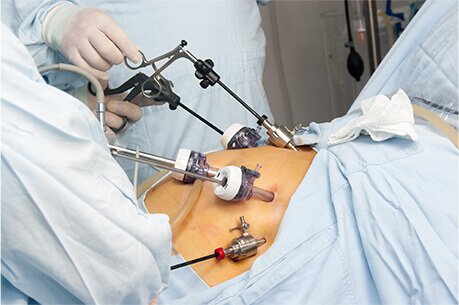
Using laparoscopic eTEP (Enhanced View Totally Extraperitoneal) or robotic hernia repair, the surgeon places a biomorphic 3D mesh behind the abdominal muscle wall through 3 tiny 5mm keyhole incisions. The mesh acts as a permanent scaffold, reinforcing the abdominal wall without tension. Patients are discharged within 24 hours.
Comprehensive Post-Operative Hernia Care & Lifestyle Protocols
Following minimal access hernia repair, adopting healthy core protection habits guarantees long-term success. Avoid heavy lifting (> 5 kg) for 4 weeks post-surgery, treat chronic cough or constipation promptly, and maintain a healthy weight using our BMI Calculator to keep abdominal wall tension low.
Long-term clinical follow-up at 1 month and 6 months post-surgery confirms complete abdominal muscle integration, allowing patients to safely return to full physical activity, fitness routines, and heavy lifting without pain or recurrence.
Clinical Expert Conclusion by Dr. Atul Peters
Navigating gastrointestinal and metabolic health choices requires accurate clinical guidance, evidence-based surgical expertise, and personalized post-treatment support. Whether you are seeking minimal access keyhole solutions for hernia or gallbladder issues, or exploring life-transforming metabolic weight loss procedures, our multidisciplinary surgical care team at Max Smart Super Speciality Hospital, Saket, is dedicated to delivering world-class, safe, and compassionate clinical care. Schedule a comprehensive consultation with Dr. Atul Peters today to take the first proactive step toward a healthier, more vibrant life.
Frequently Asked Questions (8 Detailed FAQs)
Unlike adults, umbilical hernias in infants frequently close naturally by age 2 to 3 as abdominal wall muscles mature. In adults over age 18, hernia defects NEVER close on their own.
Light walking is safe. However, heavy weightlifting, strenuous core exercises (crunches, planks), and intense straining should be strictly avoided until the hernia is surgically repaired.
Warning signs include sudden intense pain at the bulge, the bulge turning dark red or purple, inability to push the bulge back in, severe nausea, vomiting, and constipation.
Most patients undergo keyhole mesh repair, stay overnight for observation, and are discharged home comfortably within 24 hours.
You can resume light desk work within 5 to 7 days post-op. Heavy physical labor or lifting items over 5 kg should be avoided for 4 weeks to allow the mesh to integrate fully.
With modern tension-free laparoscopic mesh placement (eTEP/TAR techniques) performed by expert surgeons, recurrence rates are extremely low (< 1%).
Pregnancy increases intra-abdominal pressure and stretches the belly wall. Women planning pregnancy are advised to consult their surgeon regarding the timing of hernia repair.
Yes. Modern medical-grade polypropylene or 3D composite meshes are highly biocompatible, well-tolerated, and provide lifelong reinforcement without degradation.
Have Personal Health Questions?
Consult with Dr. Atul Peters and our expert multidisciplinary team at Max Smart Super Speciality Hospital, Saket, New Delhi.
Book Your Consultation