Robotic, laparoscopic and open hernia repair by Dr. Atul Peters, Vice Chairman, Department of Bariatric, Minimal Access & Robotic Surgery, Max Smart Super Speciality Hospital, Saket.
A hernia is a bulge that appears when an organ or tissue, usually a loop of intestine or abdominal fat, pushes through a weak spot in the abdominal wall. It will not heal on its own. It usually grows with time, and the only definitive treatment is surgery.
A hernia forms when pressure inside the abdomen meets a weak point in the muscle wall. The weakness may be present from birth, but more often it develops later in life or at the site of an earlier operation. Common triggers include:
See a doctor immediately if the bulge becomes hard, tender, discoloured or cannot be pushed back, or if it comes with vomiting, fever or severe pain. This may mean the intestine is trapped and losing its blood supply (strangulation), which needs emergency surgery.
Do not wait for pain. A hernia repaired early, when it is small and planned, is simpler and safer than one repaired as an emergency.
The right repair depends on where the hernia is, how large it is, whether it has been operated on before, and your general health. Dr. Peters treats the full range, from a simple groin hernia to a complex recurrent incisional hernia.
| Inguinal | Groin, may extend into the scrotum | Most common; far more frequent in men | Accounts for the majority of hernias. May be on one or both sides |
| Femoral | Groin, just below the inguinal crease | More often women | Small but higher risk of strangulation, so repair is generally advised |
| Umbilical | At or near the navel | Children and adults; common after pregnancy or with obesity | Often associated with a muscle gap (diastasis) |
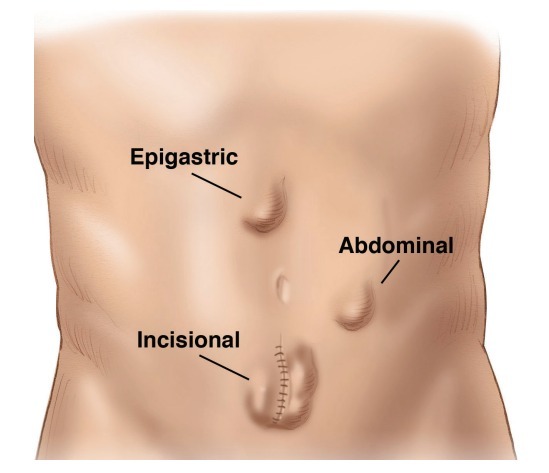
| Epigastric | Midline, between the breastbone and navel | Adults | Often small, can be painful |
| Incisional | At the scar of a previous operation | Anyone with prior abdominal surgery | Can be large, multiple or recurrent. Often needs abdominal wall reconstruction |
| Ventral | Anywhere on the front abdominal wall | Adults | Umbilical, epigastric and incisional hernias are all ventral hernias |
| Recurrent | Site of an earlier hernia repair | Anyone | Needs careful planning and an experienced surgeon |
| Parastomal | Around a stoma | Patients with a colostomy or ileostomy | Technically demanding repair |
Spigelian, Richter's, Amyand's, De Garengeot's and Littre's hernias are uncommon and are often found only during investigation or emergency surgery. Each has its own risks, and an experienced surgeon's assessment matters.
Most hernias are diagnosed on clinical examination. An ultrasound, CT or MRI is used when the diagnosis is unclear, the hernia is large or recurrent, or complex reconstruction is being planned.
If your main symptoms are heartburn, chest discomfort or difficulty swallowing rather than a groin or abdominal bulge, you may be dealing with a hiatal hernia. This is a different condition, where part of the stomach moves up through the diaphragm into the chest, and Dr. Peters treats it as part of GERD surgery, usually with fundoplication, rather than the abdominal wall repairs described on this page.
Robotic surgery is the most advanced way to repair a hernia today. Through a few small incisions, the surgeon works from a console with a magnified 3D view and wristed instruments that move like the human hand, with a precision that is hard to match with straight laparoscopic instruments. For hernia repair, that precision helps in the parts of the operation that decide how strong the repair will be: closing the defect, creating space for the mesh and placing it flat with generous overlap.
A large or recurrent ventral or incisional hernia is more than a hole. The whole abdominal wall has often weakened, stretched or separated. Abdominal wall reconstruction (AWR) rebuilds that wall so it works as one strong unit again.
In robotic AWR, Dr. Peters:
The techniques in this family include robotic retromuscular repair, robotic TAR (transversus abdominis release), robotic TAPP and robotic eTEP, chosen to suit your hernia. Historically this reconstruction meant a large open incision. Robotics allows the same principles to be applied through small incisions.
Robotic retromuscular repair has been compared with open surgery in a randomised trial, which found a shorter hospital stay with the robotic approach and similar overall complication and recurrence outcomes at two years (ORREO trial). A pooled analysis of robotic inguinal hernia repair found lower recurrence compared with laparoscopy, and less opioid use compared with open surgery (Surgical Endoscopy, 2023). Robotic surgery is not right for every patient, and Dr. Peters will tell you honestly which approach suits you.
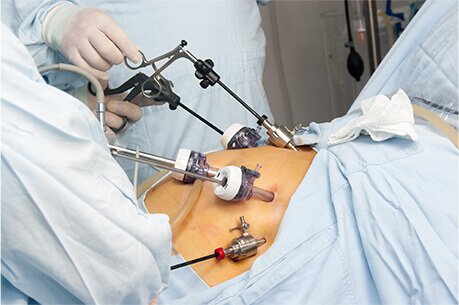
Laparoscopic (keyhole) repair is a proven, minimally invasive option, and Dr. Peters is highly experienced in it. Through small incisions, a camera and slim instruments are used to repair the hernia from inside, and a mesh reinforces the weak area.
Laparoscopic repair suits many primary inguinal hernias and smaller ventral hernias. For larger, recurrent or complex hernias, Dr. Peters will often recommend the robotic approach, which offers finer suturing and better access for reconstruction.
Open repair uses a single incision over the hernia. The bulge is returned to its place, the weak area is closed with stitches and usually reinforced with a mesh. It is the oldest technique, and it still has a role.
Open repair generally means a longer incision, more wound pain and a somewhat longer recovery than minimally invasive surgery. Dr. Peters recommends it only when it is the safest or most effective option for you, never simply because it is the only one on offer.
| Incision | A few small incisions | A few small incisions | One longer incision |
| Visualisation | Magnified 3D view | Magnified 2D view | Direct view |
| Instrument movement | Wristed, hand-like | Straight, limited angles | Direct by hand |
| Suturing and defect closure | Easiest to perform precisely | More demanding | Straightforward |
| Complex, large or recurrent hernias | Well suited, with the most precise suturing | Limited | Effective, with a larger wound |
| Post-operative pain | Low | Low | Higher |
| Hospital stay | Often within a day | Same day to next day | Often longer |
| Wound complications | Fewer | Fewer | More frequent |
| Emergency and contaminated cases | Selected cases | Selected cases | Often the safest option |
The best approach is the one that suits your hernia and your health. Dr. Peters offers all three, so the recommendation is based on you and not on what is available.
Repairing a hernia with stitches alone puts tension on tissue that was already weak. Modern repair therefore reinforces the area with a surgical mesh, which supports the abdominal wall while your own tissue grows into it. Mesh repair is the accepted standard for most adult hernias. The choice of mesh depends on the type and location of the hernia:
Non-absorbable mesh stays in the body permanently and provides long-term reinforcement. Dr. Peters chooses the mesh, its size and its position for each patient.
Surgery is done under general anaesthesia at Max Smart Super Speciality Hospital, Saket. Most groin and small ventral hernia patients go home the same day or the next day. Larger reconstructions or complex hernias may need a slightly longer stay.
Exact timelines vary with the size of the hernia and the repair, and Dr. Peters will give you a personalised plan.
The cost of hernia surgery in Delhi is not the same for every patient. It depends on factors such as:
Because of this, Dr. Peters and his team share a personalised cost estimate after your consultation and examination, rather than quoting a fixed figure in advance. Most health insurance plans cover hernia surgery, and our team assists with pre-authorisation and paperwork.
A hernia repair is only as good as the surgeon's judgment and hands. As a hernia specialist with nearly three decades of surgical experience and deep robotic surgery expertise, Dr. Peters brings that judgment to every hernia he treats.
Obesity is one of the biggest risk factors for hernias and for hernia recurrence. As a leading bariatric surgeon, Dr. Peters can plan weight-loss surgery together with, or before, hernia repair when it improves the outcome, an integrated approach to the whole patient.
Book a consultation with Dr. Atul Peters to find out which hernia you have, whether it needs surgery and which approach is best for you. International patients can contact the Travel Desk.