

Key Takeaways at a Glance
- Early Diagnosis Prevents Emergencies: A hernia is a structural gap in the muscle wall through which internal organ tissue bulges.
- Sign 1 - Visible Bulge: A soft lump in the groin, belly button, or surgical scar area.
- Sign 2 - Heaviness & Dragging Discomfort: Pain that worsens after standing or lifting heavy objects.
- Sign 3 - Sharp Localized Pain: Increasing tenderness around the hernia neck.
- Sign 4 - Nausea & Constipation: Indicates trapped intestine (incarceration).
- Sign 5 - Discoloration & Severe Pain: EMERGENCY RED FLAG for strangulation.
What Is a Hernia & Why Should You Catch It Early?
A hernia occurs when an internal organ (usually a loop of intestine or abdominal fat) pushes through a weak spot or tear in the surrounding muscle fascia wall. Hernias can develop in the groin (inguinal hernia), belly button (umbilical hernia), upper stomach (epigastric hernia), or previous surgical scars (incisional hernia).
Because hernias often start as small, painless bulges, many people ignore them for months or years. However, hernias never heal on their own and naturally enlarge over time under daily physical strain. If you are specifically dealing with a navel bulge, read our medical analysis on whether umbilical hernias can be treated without surgery.
Recognizing the 5 warning signs of a hernia early allows for simple, elective keyhole repair before dangerous complications like intestinal strangulation develop.
The 5 Warning Signs of a Hernia
1. A Visible or Palpable Bulge Under the Skin
The most recognizable sign of a hernia is a soft lump or swelling beneath the skin in the groin, navel, or abdomen. The bulge is most prominent when standing, coughing, laughing, or straining, and may disappear when lying down flat.
2. A Feeling of Heaviness or Dragging Discomfort
Many patients experience an aching, heavy, or "dragging" sensation in the lower abdomen or scrotum towards the end of the day, especially after standing or walking for long periods.
3. Pain During Lifting, Bending, or Coughing
Sharp or burning pain that flares up specifically when increasing abdominal pressure—such as carrying heavy groceries, lifting weights, coughing, or straining during bowel movements.
4. Nausea, Vomiting, and Inability to Pass Gas (Incarceration)
If the bulging intestine becomes trapped inside the narrow hernia neck, bowel contents cannot pass. This causes severe abdominal distension, cramping, nausea, and vomiting.
5. Sudden Discoloration and Severe Pain (Strangulation Red Flag!)
If the hernia bulge suddenly turns dark red, purple, or blue and becomes intensely painful to touch, the blood supply to the trapped intestine has been cut off. **This is a life-threatening surgical emergency requiring immediate operation within hours.**
Modern Keyhole Repair: 3D Mesh Hernioplasty
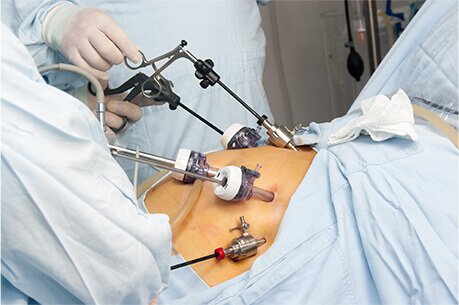
With modern robotic hernia surgery in Delhi and laparoscopic eTEP/TAR techniques, hernia defects are permanently sealed using biomorphic 3D meshes placed behind the muscle layer through 3 tiny 5mm keyhole incisions, ensuring 24-hour hospital discharge and minimal pain. If you experience abdominal pain radiating to your back, also check our post on whether gallbladder stones cause back pain.
Comprehensive Diagnostic & Prevention Strategies for Hernia Care
If you notice any of the 5 warning signs of a hernia, seeking an early clinical consultation avoids emergency complications. Preventive measures include maintaining a healthy body weight with our BMI Calculator, using proper leg-lifting techniques, and treating chronic coughing or constipation.
Clinical Expert Conclusion by Dr. Atul Peters
Navigating gastrointestinal and metabolic health choices requires accurate clinical guidance, evidence-based surgical expertise, and personalized post-treatment support. Whether you are seeking minimal access keyhole solutions for hernia or gallbladder issues, or exploring life-transforming metabolic weight loss procedures, our multidisciplinary surgical care team at Max Smart Super Speciality Hospital, Saket, is dedicated to delivering world-class, safe, and compassionate clinical care. Schedule a comprehensive consultation with Dr. Atul Peters today to take the first proactive step toward a healthier, more vibrant life.
Frequently Asked Questions (8 Detailed FAQs)
Yes. In early stages, patients often feel a deep aching or burning pain in the groin or abdomen during physical exertion before a distinct lump bulges out.
A reducible hernia can be gently pushed back into the abdomen or disappears when lying down. A non-reducible (incarcerated) hernia stays stuck outside the abdominal wall and requires prompt surgical evaluation.
Heavy lifting, chronic coughing, straining, and obesity do not create the initial muscle weakness, but they increase intra-abdominal pressure that forces tissue through pre-existing weak spots.
A physical examination by an experienced surgeon is usually sufficient. In subtle cases, a high-resolution groin/abdominal ultrasound or CT scan confirms the diagnosis.
Yes. Inguinal hernias are 8 to 10 times more common in men due to the anatomical passage of the spermatic cord through the inguinal canal.
Through 3 tiny keyholes, the surgeon gently pulls the herniated tissue back inside and places a high-strength mesh behind the muscle wall, reinforcing the entire weak area without tension.
Patients go home within 24 hours, walk pain-free the next day, and return to desk work in 5 to 7 days.
With modern laparoscopic eTEP/TAR mesh placement performed by expert hernia surgeons in Delhi, recurrence rates are extremely low (< 1%).
Have Personal Health Questions?
Consult with Dr. Atul Peters and our expert multidisciplinary team at Max Smart Super Speciality Hospital, Saket, New Delhi.
Book Your Consultation